Shadow AI: The Growing Cybersecurity Blind Spot for Businesses.

Written by
admin

Get the oars in the water and start rowing. Execution is the single biggest factor in achievement so the faster and better your execution.
Shadow AI: The Growing Cybersecurity Blind Spot for Businesses
admin
As generative AI tools like ChatGPT gain popularity, a new cybersecurity risk is emerging — shadow AI. Employees are increasingly using these tools without IT approval, unknowingly exposing sensitive company data. Yet many organizations continue to underestimate the threat and delay taking action.
Just as shadow IT (the use of unauthorized software and hardware) has long posed challenges, shadow AI is now raising alarms among cybersecurity experts.
“AI often has broader access to data than traditional shadow IT, increasing the risk if a breach occurs,” warns Melissa Ruzzi, Director of AI at SaaS security firm AppOmni.
Unlike shadow IT, AI tools can analyze, extract, and potentially leak large amounts of sensitive data. If used improperly, they may:
 Feed confidential data into AI models that can be leaked or accessed.
Introduce vulnerabilities for attackers to exploit.
Violate data privacy laws by mishandling personal or regulated information.
Feed confidential data into AI models that can be leaked or accessed.
Introduce vulnerabilities for attackers to exploit.
Violate data privacy laws by mishandling personal or regulated information.
Ruzzi explains that shadow AI spans many formats — from generative AI tools to meeting transcription software, AI coding assistants, chatbots, data visualization tools, and embedded AI in CRMs.
Ruzzi highlights that unauthorized GenAI tools (like ChatGPT) pose the greatest immediate risk, as they typically lack any form of oversight, security vetting, or governance.
Unauthorized GenAI tools lack oversight and vetting
Embedded AI in SaaS platforms often runs without visibility
Both approaches pose governance and security challenges
Traditional security solutions, such as Cloud Access Security Brokers (CASBs), can detect some AI usage. But many fall short when it comes to identifying shadow AI embedded deep within SaaS applications.
Traditional tools miss hidden AI inside SaaS
Older systems aren't built for evolving AI threats
Detection and enforcement lack adaptability
Shadow AI usage can easily breach global data protection laws, including:
GDPR (EU): Improper data handling, overcollection, or lack of security controls.
CCPA/CPRA (California): Violations of user rights like data access and deletion.
HIPAA (U.S. Healthcare): Unauthorized access to or sharing of protected health information (PHI).
Failure to comply can result in legal penalties, financial loss, and reputational damage. “If shadow AI accesses personal or health data without proper consent or security, it violates multiple privacy laws,” says Ruzzi. Other regulations like Brazil’s LGPD and Canada’s PIPEDA further expand these obligations, depending on where customers are located.


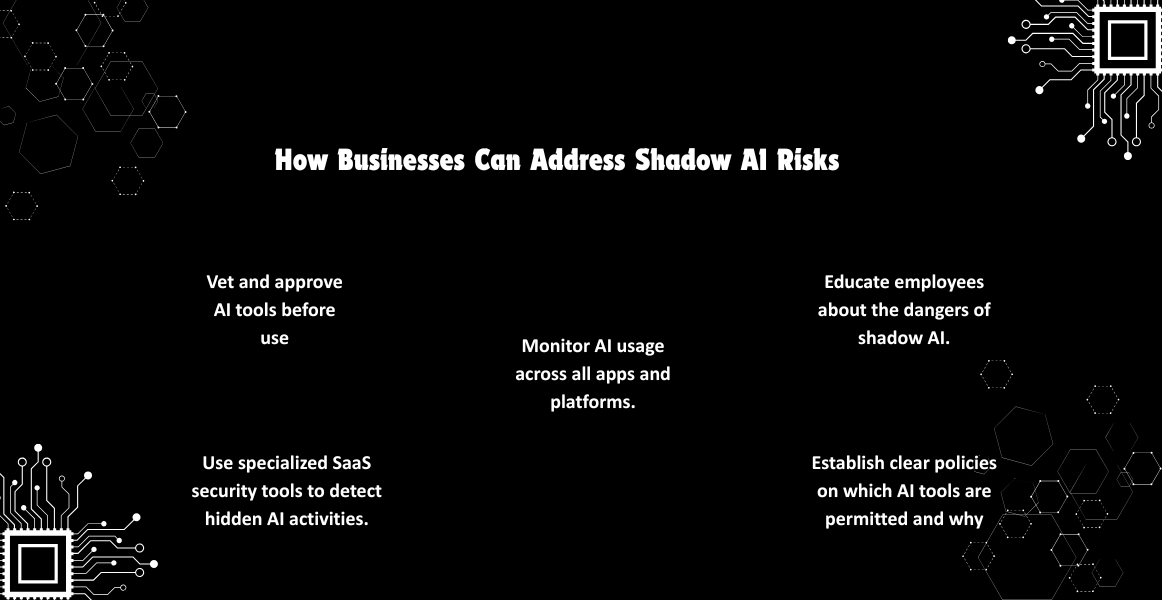
To minimize legal and security threats, organizations must:
Vet and approve AI tools before use.
Educate employees about the dangers of shadow AI.
Monitor AI usage across all apps and platforms.
Use specialized SaaS security tools to detect hidden AI activities.

on which AI tools are permitted and why. “Shadow AI isn’t going away — it’s growing. The best defense is strong governance, employee awareness, and AI activity monitoring,” Ruzzi concludes.