OpenAI Launches ChatGPT ‘Study Mode’ in India: Free Multilingual Tutoring Tool Goes Live

Written by
admin

Get the oars in the water and start rowing. Execution is the single biggest factor in achievement so the faster and better your execution.
OpenAI Launches ChatGPT ‘Study Mode’ in India: Free Multilingual Tutoring Tool Goes Live
admin
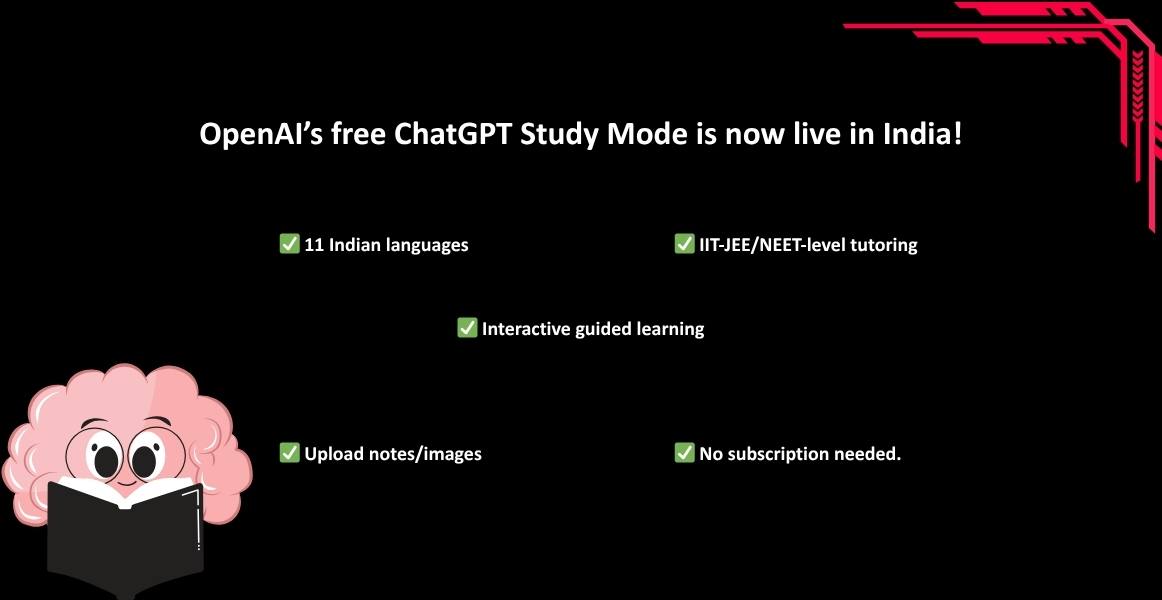
New Delhi: OpenAI has rolled out its ChatGPT Study Mode to Indian users, offering a free, multilingual, and interactive learning tool designed to transform how students tackle academics—from IIT-JEE prep to regional language studies. The launch follows extensive testing with Indian students and partnerships with local ed-tech firms.
 Multilingual Support & Local Relevance: Available in 11 Indian languages (including Hindi, Tamil, Bengali, and Marathi) with multimodal input (text, images, PDFs).
Competitive Exam Performance: Tested on competitive exams like IIT-JEE, with early results showing “strong performance” on advanced questions.
Socratic Tutoring Approach: Instead of direct answers, Study Mode uses guided questioning to break down concepts step-by-step (e.g., Bayes’ theorem or organic chemistry).
Adaptive Learning & Zero-Cost Access: Adapts to the user’s proficiency level—beginner to advanced—and references past chats if “Memory” is enabled. Free for all logged-in users (no paid plan required); paid tiers offer higher response quality and tools like image analysis.
Access the Tool: Open ChatGPT (web/iOS/Android) → Tap “Tools”→Select “Study and Learn” from the dropdown.
Set Your Learning Goals: Use example prompts like “Explain quantum physics basics in Hindi” or “Help solve this IIT-level calculus problem.” ChatGPT will begin with clarifying questions (e.g., “What’s your current understanding?”).
Interactive Learning: Receive scaffolded lessons, quizzes, and feedback. Upload images of past papers or handwritten notes for analysis. Switch languages mid-session (e.g., English to Tamil) for seamless learning.
Track Progress: While real-time progress dashboards are upcoming, users can revisit chats to monitor improvement.
Ed-tech Partnerships: OpenAI collaborates with Indian startups to integrate local curricula and language nuances via APIs.
IIT Testing: Model accuracy was validated using questions from premier Indian institutions.
Bridging Gaps: Targets resource disparities by offering free tutoring in underserved languages.
Voluntary Engagement: Students can toggle Study Mode off to get direct answers—no admin controls exist yet to enforce usage.
Inconsistencies: Responses may vary due to reliance on “custom system instructions” (to be embedded in future models).
No Visual Aids Yet: Diagrams/graphs support is planned but not live.
Multilingual Support & Local Relevance: Available in 11 Indian languages (including Hindi, Tamil, Bengali, and Marathi) with multimodal input (text, images, PDFs).
Competitive Exam Performance: Tested on competitive exams like IIT-JEE, with early results showing “strong performance” on advanced questions.
Socratic Tutoring Approach: Instead of direct answers, Study Mode uses guided questioning to break down concepts step-by-step (e.g., Bayes’ theorem or organic chemistry).
Adaptive Learning & Zero-Cost Access: Adapts to the user’s proficiency level—beginner to advanced—and references past chats if “Memory” is enabled. Free for all logged-in users (no paid plan required); paid tiers offer higher response quality and tools like image analysis.
Access the Tool: Open ChatGPT (web/iOS/Android) → Tap “Tools”→Select “Study and Learn” from the dropdown.
Set Your Learning Goals: Use example prompts like “Explain quantum physics basics in Hindi” or “Help solve this IIT-level calculus problem.” ChatGPT will begin with clarifying questions (e.g., “What’s your current understanding?”).
Interactive Learning: Receive scaffolded lessons, quizzes, and feedback. Upload images of past papers or handwritten notes for analysis. Switch languages mid-session (e.g., English to Tamil) for seamless learning.
Track Progress: While real-time progress dashboards are upcoming, users can revisit chats to monitor improvement.
Ed-tech Partnerships: OpenAI collaborates with Indian startups to integrate local curricula and language nuances via APIs.
IIT Testing: Model accuracy was validated using questions from premier Indian institutions.
Bridging Gaps: Targets resource disparities by offering free tutoring in underserved languages.
Voluntary Engagement: Students can toggle Study Mode off to get direct answers—no admin controls exist yet to enforce usage.
Inconsistencies: Responses may vary due to reliance on “custom system instructions” (to be embedded in future models).
No Visual Aids Yet: Diagrams/graphs support is planned but not live.

 Upcoming Features: OpenAI confirms additions like progress dashboards, visual explanations, and expanded Edu-plan access for schools.
Educational Vision: As VP Leah Belsky stated, the goal is to make AI a “core infrastructure” for education—especially in markets like India.
Upcoming Features: OpenAI confirms additions like progress dashboards, visual explanations, and expanded Edu-plan access for schools.
Educational Vision: As VP Leah Belsky stated, the goal is to make AI a “core infrastructure” for education—especially in markets like India.

Student Impact: “Study Mode helped me grasp thermodynamics intuitively—like a personal tutor,” shares Riya Mehta, a Kolkata NEET aspirant
