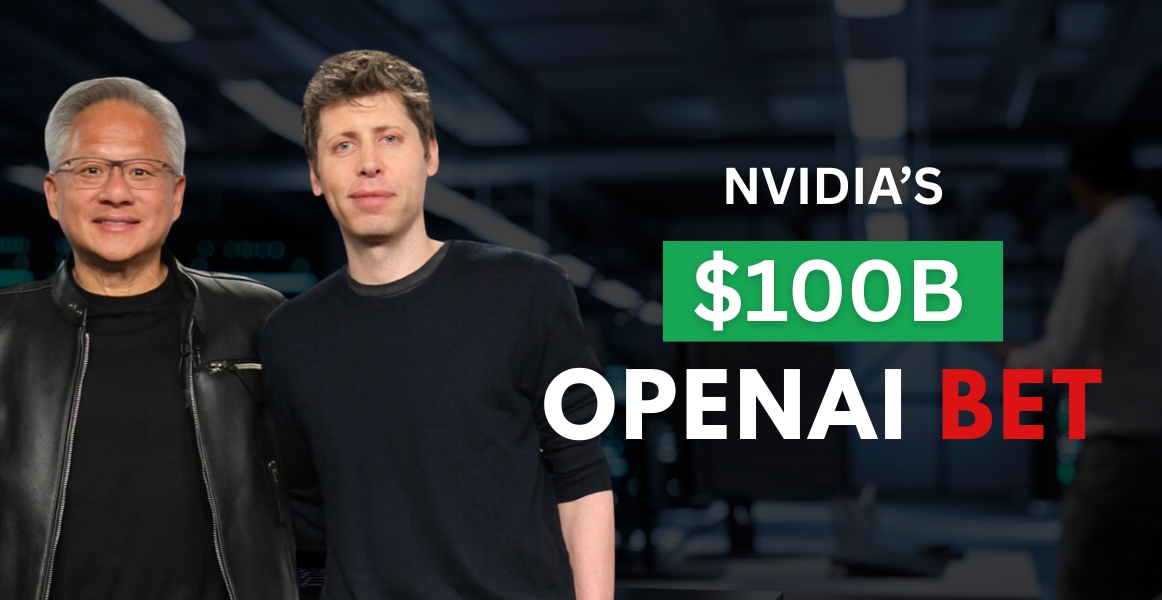
Artificial intelligence isn’t just shaping the future anymore it’s reshaping the balance of power among tech giants today. On September 23, Nvidia announced a massive $100 billion partnership with OpenAI, a deal that instantly set off alarms in the antitrust world.
Why? Because when the world’s most dominant AI chipmaker teams up with the leading AI software developer, the ripple effects are felt across the entire industry.
What’s the Deal?
- Nvidia invests up to $100B in OpenAI.
- In return,OpenAI buys millions of Nvidia GPUs to power frontier models like ChatGPT and beyond.
- This marks one of the largest-ever partnerships in AI history and signals just how expensive frontier AI has become.
The cost of chips, data centers, and power has pushed the industry toward a handful of firms able to finance projects on that scale,” explains Sarah Kreps, Director of Cornell’s Tech Policy Institute
Why Antitrust Experts Are Worried
Nvidia already controls over 50% of the GPU market. Its chips are the lifeblood of AI training, used by nearly every serious AI company. Now, with a direct financial interest in OpenAI’s success, experts fear Nvidia could tilt the playing field:
- Preferential treatment OpenAI might get better pricing, faster deliveries, or priority access to chips.
- Market squeeze Rivals like Anthropic, Cohere, or startups could find it harder (and more expensive) to scale.
- Concentration of power With fewer players able to compete, innovation could bottleneck.
Rebecca Haw Allensworth, an antitrust professor at Vanderbilt, puts it bluntly:
They’re financially interested in each other’s success. That creates an incentive for Nvidia to not sell chips on the same terms to other competitors of OpenAI.
The Political Angle: Growth vs. Competition
Here’s where it gets tricky. U.S. administrations (past and present) have had to walk a fine line:
- Trump’s AI stance: deregulation, pro-growth, clear the runway for U.S. dominance.
- Biden’s AI stance: more guardrails, DOJ & FTC scrutiny of Big Tech to protect competition.
- Now (Trump again): A mixed bag supporting rapid AI growth but signaling DOJ interest in keeping competition alive.
As antitrust lawyer Andre Barlow notes:
The question is whether the agencies see this investment as pro growth or something that could slow AI growth.
What This Means for the AI Ecosystem
- Barriers to entry rise → Smaller AI startups may struggle to compete with giants who can afford billion-dollar partnerships.
- Cloud & chip dependency deepens → With Microsoft, Google, Amazon, and now OpenAI locked into GPU supply deals, the AI “compute race” tightens further.
- Prices and innovation risks → If Nvidia starts prioritizing OpenAI, others could face chip shortages, higher costs, and slower R&D cycles.
- Global implications → The U.S. solidifies its lead in AI hardware-software integration, leaving European and Asian competitors scrambling for alternatives.
Is This a Power Play or a Growth Catalyst?
Nvidia insists that “every customer remains a top priority, with or without any equity stake.” But history shows that when scale and financial interests converge, competition often suffers. At the same time, this deal could accelerate OpenAI’s ability to push the boundaries of what’s possible, unlocking models more advanced than GPT-4 and revolutionizing industries from healthcare to robotics. So, are we witnessing the birth of the next AI superpower alliance, or the beginning of a chokehold on AI competition?
Final Takeaway
This partnership is a double-edged sword:
- On one side: it fuels faster innovation, more powerful AI models, and U.S. global dominance.
- On the other: it raises serious antitrust red flags that regulators can’t afford to ignore.
The coming months will reveal whether regulators treat Nvidia’s OpenAI bet as a growth engine or a market stranglehold. Either way, one thing is certain: AI’s future won’t just be shaped by algorithms, but by who controls the chips, the money, and the rules of the game.